
AI Writing vs Human Writing: Key Differences & Comparison
By Muhammad Shamir Taloo – Last updated: Sep 16, 2026
AI-powered tools have changed how content is created, but they have not changed who creates meaning. In 2026, the real debate is no longer AI writing vs human writing, it is how both can work together to produce faster, smarter, and more trustworthy content.
Businesses, bloggers, students, and marketers now rely on top AI writing tools for speed and scale. At the same time, human writing creativity and judgment still determine whether content connects, persuades, and ranks.
AI-generated content has advanced rapidly, to the point where 84% of readers cannot tell it apart from human writing in blind evaluations. However, the strongest results come from a hybrid approach, as 62% of top-performing marketing teams now combine AI efficiency with human creativity instead of relying on full automation. This guide explains how AI generated content and human written content compare and why a hybrid AI + human workflow is the future.
1. AI Copywriting Tools vs Human Writers: Main Differences
| Factor | AI Writing | Human Writing |
|---|---|---|
| Creativity | Predictive | Original |
| Accuracy | High for grammar | High for meaning |
| Speed | Extremely fast | Slower but deliberate |
| Emotion | Simulated | Genuine |
| SEO value | Needs editing | Naturally aligned |
| Trust | Limited | High |
| Cost | Low ($10 – $80/month) | Higher ($0.05 – $0.50+/word) |
This AI content vs human content contrast shows why AI writing vs human writing is not about replacement, it is about complementing strengths.
2. What Is AI Writing?
AI writing refers to content created or assisted by AI writing tools that use machine learning and large language models to generate, rewrite, summarize, or optimize text.
These tools analyze patterns across billions of sentences to predict what comes next.
Popular examples include Grammarly, QuillBot, and Writesonic, which help with grammar, tone, rewriting, summarization, and content structure. In 2026, the writing landscape is no longer a strict binary; instead, a human-led, AI-assisted workflow has become the industry standard, with roughly 64% of content teams using AI as a supportive editing and research assistant rather than a primary author.
However, while AI generated content can sound natural, AI does not “understand” ideas. It predicts text based on probability, not meaning. That is why AI writing accuracy is strong for grammar and structure but weaker for logic, originality, and lived experience.
3. What Is Human Writing?
Human writing is driven by intent, emotion, culture, and experience.
Humans don’t just assemble words, they communicate purpose, belief, humor, fear, and persuasion. This is why human written content remains the standard for storytelling, branding, and authority.
What makes human writing creativity powerful is context:
- Cultural awareness
- Emotional intelligence
- Real-world experience
- Editorial judgment
These elements define human writing quality, something AI cannot truly replicate.
4. Pros & Cons of Automated Content Generation: Key Statistics & Insights
4.1 AI vs Human Writing Quality Scores
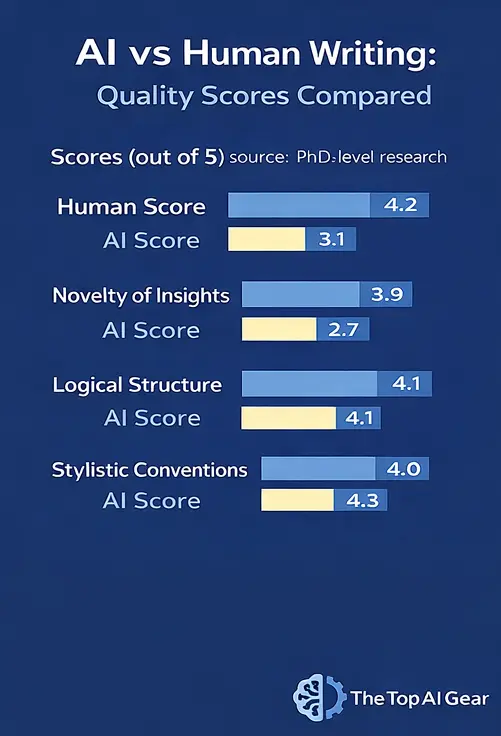
Research comparing AI to PhD-level human writers reveals specific strengths for each:
| Metric | Human Score | AI Score |
|---|---|---|
| Analytical Depth | 4.2 / 5 | 3.1 / 5 |
| Novelty of Insights | 3.9 / 5 | 2.7 / 5 |
| Logical Structure | 3.8 / 5 | 4.1 / 5 |
| Stylistic Conventions | 4.0 / 5 | 4.3 / 5 |
4.2 Usage and Market Penetration
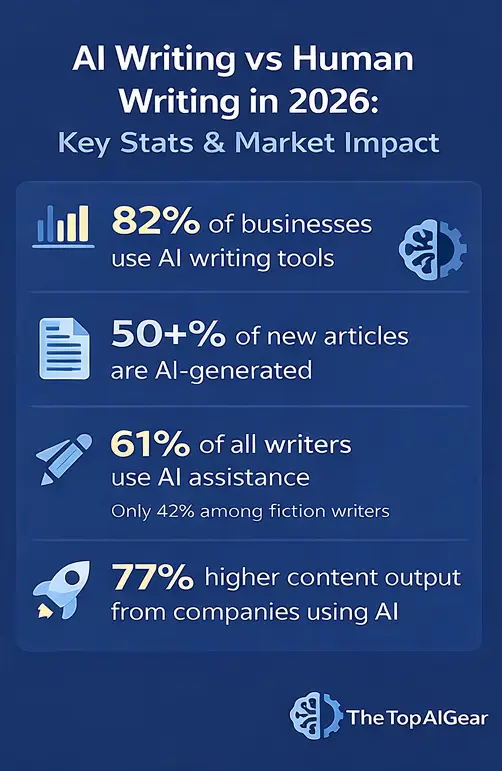
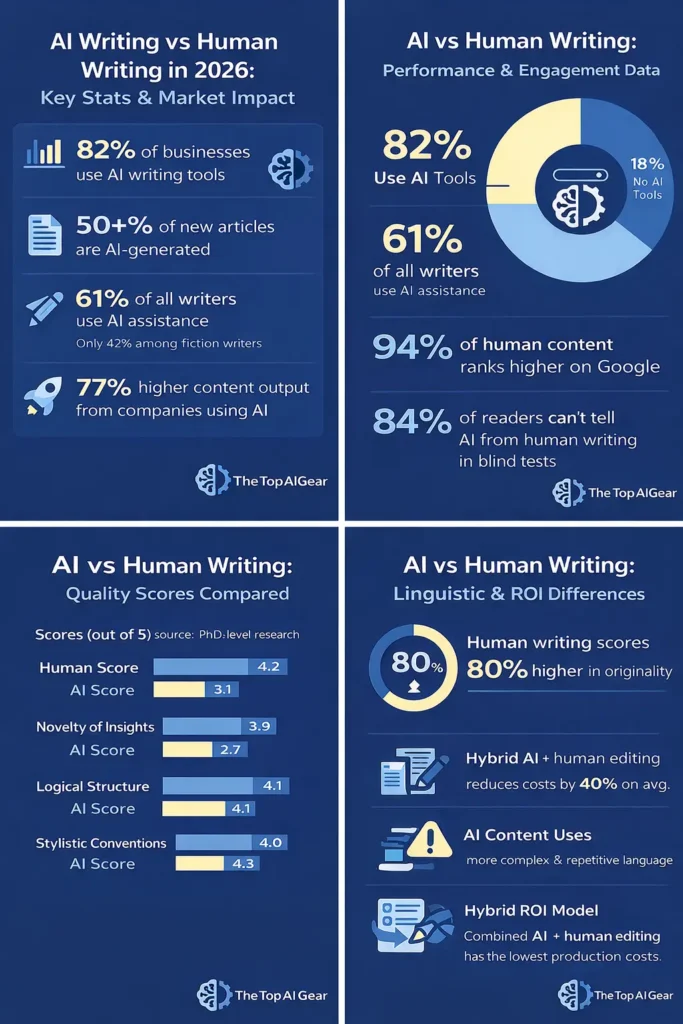
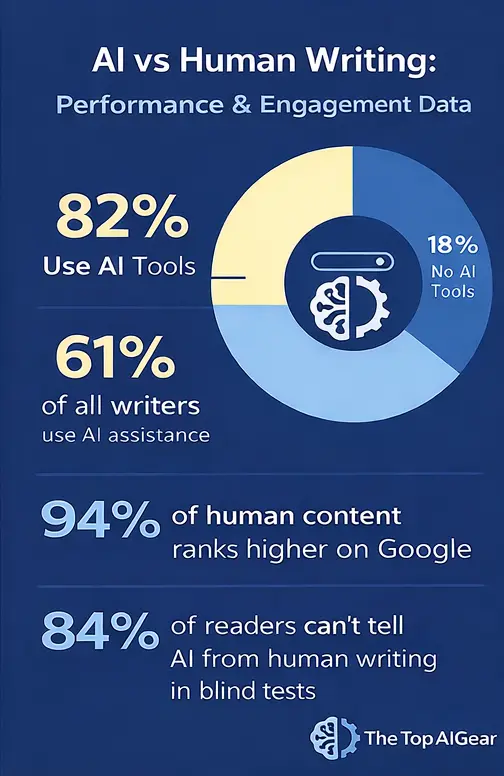
- Mass Adoption: Approximately 82% of businesses now utilize AI writing tools for content creation as of early 2026.
- Content Volume: Over 50% of new articles published on the internet are now AI-generated.
- Writer Adoption: Roughly 61% of all writers use AI to assist their work; this adoption is lower among fiction writers at 42%.
- Efficiency Gains: Organizations using AI report 59% faster content creation and a 77% increase in total output volume.
4.3 Performance & Engagement Metrics
- Traffic Superiority: Human-generated content consistently outperforms AI, receiving 5.44 times more traffic than AI-only pieces.
- Search Rankings: In 94% of cases, human-written content ranks higher on Google than AI-generated content. In 2026, a massive data study revealed that human-written pages are 8 times more likely to rank #1 on Google than purely AI-generated content. While AI content often sits in lower Page 1 positions, purely AI-generated text only captures the top spot 9% of the time compared to human content’s 80%.
- Consumer Preferences: Despite higher traffic for humans, blind tests show that 84% of readers cannot distinguish between AI and human writing. Some studies even suggest a slight preference for AI’s clarity in specific short-form contexts.
- Accuracy Concerns: A significant performance gap remains in reliability; approximately 70% of AI-generated content contains at least one factual error.
4.4 Linguistic Differences & Hybrid ROI Advantage
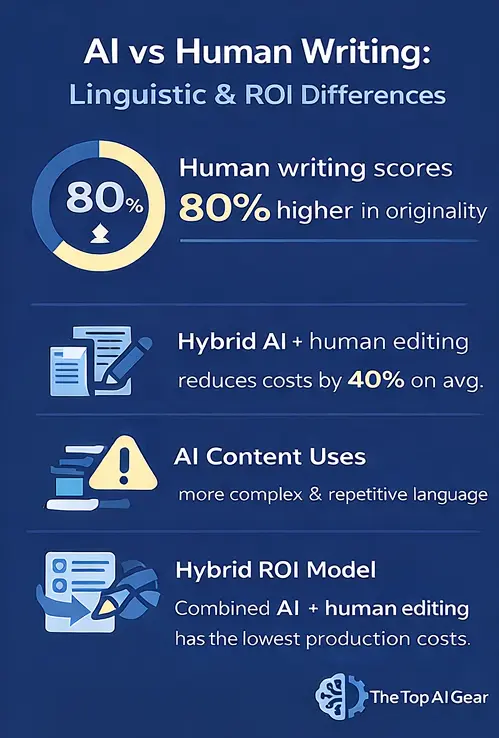
- Complexity: AI writing typically uses more “difficult” content words and adjectival modifiers, while human writing utilizes a higher proportion of function words and unique vocabulary.
- Originality: Human writing outscores AI in linguistic originality by roughly 80% in poetry and 100% in novels.
- Hybrid ROI: The most cost-effective model in 2026 is the hybrid approach (AI generation + human editing), which reduces production costs by an average of 40% while maintaining quality.
5. Strengths of AI Writing
The biggest AI writing advantages come from speed and consistency.
AI excels at:
- AI writing speed for fast drafts
- Grammar and tone optimization
- Paraphrasing and summarization
- Formatting for SEO
- Multilingual output
This makes AI writing efficiency ideal for scaling content, rewriting articles, and producing large volumes of text.
6. Strengths of Human Writing
Humans still dominate where meaning matters. According to Google’s guidance on creating helpful, people-first content, content that demonstrates real expertise, authoritativeness, and trust is rewarded in search, emphasizing the importance of human insight and editorial judgment.
Human writing creativity allows:
- Original ideas
- Brand voice
- Emotional storytelling
- Persuasion
- Editorial judgment
This emotional intelligence gives human writing quality its edge, especially in trust-based content.
7. Where AI Writing Falls Short (EEAT Signal)
Even the best AI has limits. According to Google’s Quality Rater Guidelines, AI-generated content may lack trust and authority if it is not carefully edited by humans.
AI writing limitations include:
- Hallucinated facts
- Shallow insight
- Lack of lived experience
- Weak authority signals
This is especially critical since Google’s official search guidelines confirm that its generative AI systems rely on the exact same core helpfulness and trust metrics as its standard search engine. If your AI content is too thin to rank in traditional search, it will be automatically excluded from AI Overviews.
These AI content risks are why AI content detection and editorial oversight matter. Google values human-edited AI because trust and expertise cannot be automated.
8. When Should You Use AI Writing Tools?
AI assisted writing is ideal for:
- First drafts
- Paraphrasing
- Research summaries
- SEO formatting
- Email and business writing
This is where AI writing tools save time and remove friction.
9. When Human Writing Is Still Essential?
Original human writing remains essential for:
- Thought leadership
- Brand storytelling
- Sensitive content
- Legal or ethical topics
- Editorial control
This is where human editing skills protect quality and credibility.
10. Hybrid Approach: Combining AI Speed with Human Editing
The future is hybrid AI writing.
- AI handles speed.
- Humans handle meaning.
This human-AI collaboration creates:
- Faster production
- Better trust
- Higher SEO quality
- Lower risk
This balanced model outperforms both AI-only and human-only workflows.
11. How AI Writing Tools (Grammarly & More) Fit into This Hybrid Workflow?
Professional writers don’t choose between tools, they use both.
- Grammarly ensures correctness, clarity, and tone.
- QuillBot improves structure, paraphrasing, and flow.
- Writesonic Generates SEO-optimized drafts and content workflows.
Together with human editing, they produce high-quality AI content that meets both SEO and editorial standards.
12. AI Writing vs Human Writing for SEO
AI writing for SEO works best when humans guide it. According to Google Search Central’s guidance on generative AI content, AI-generated content can rank well if it is helpful, high-quality, and focused on users.
Google rewards content that shows:
- Experience
- Expertise
- Authority
- Trust
That is why human SEO writing combined with AI tools ranks better than raw AI output.
13. FAQs
13.1 Is AI writing good?
AI writing is good for speed, grammar correction, and content structuring. However, it performs best when combined with human editing to ensure accuracy, originality, and meaningful context.
13.2 How is AI writing detected?
AI writing is detected by analyzing text predictability, sentence patterns, repetition, and lack of personal experience. Detection tools look for statistically generated language. However, when AI content is edited by humans, it becomes far harder to identify reliably.
13.3 Is AI writing better than human writing?
AI is faster, but humans create better meaning and trust.
13.4 Is AI taking over writing jobs?
No. AI is changing how writing is done, not eliminating writers. It automates repetitive tasks like drafting and editing, while humans remain essential for creativity, strategy, emotional depth, and decision-making.
13.5 Can AI replace human writers?
No. AI lacks creativity, judgment, and emotional intelligence.
13.6 Is AI generated content bad for SEO?
No, but it must be edited by humans to rank well.
13.7 Why is human writing worth defending in the age of ChatGPT?
Human writing delivers emotion, lived experience, critical thinking, and authentic voice, qualities AI cannot replicate. These elements build trust, influence readers, and align with Google’s quality and EEAT standards.
13.8 What is the best way to use AI writing tools today?
The best approach is hybrid writing. Use AI tools for efficiency and structure, then rely on human judgment for refinement, credibility, and final quality control.
13.9 Which is better for professionals, AI or human writing?
The best results come from AI + human collaboration.
📣 Final Verdict: AI Writing vs Human Writing in 2026 (The Real Truth)
In 2026, the debate between AI writing vs human writing is no longer about replacement, it is about amplification. Moreover, AI writing has clearly proven its value in speed, efficiency, and consistency. It can generate outlines, refine grammar, optimize SEO structure, and even rephrase content in seconds. However, while AI excels at processing patterns and producing scalable content, it still lacks the lived experience, emotional depth, and strategic intent that define truly persuasive communication.
Why Human Writing Still Sets the Gold Standard
On the other hand, human writing remains the gold standard for originality, storytelling, and trust. Humans understand nuance, culture, brand voice, and audience psychology in ways machines simply cannot replicate. Whether it is thought leadership, emotional storytelling, or brand messaging, human-written content continues to outperform when credibility and connection matter most.
The Rise of Hybrid AI-Human Writing Workflows
That is why the smartest creators, marketers, and businesses no longer choose one over the other. Instead, they rely on a hybrid AI-human workflow. AI handles the heavy lifting, drafting, summarizing, formatting, and SEO optimization, while humans provide judgment, creativity, ethical oversight, and strategic direction. Tools like Grammarly improve tone, clarity, and correctness, while QuillBot enhances structure and rewriting and Writesonic is best for SEO and Blog Writing but it is human editing that turns that output into content people actually trust and engage with.
🏆 Final Answer: Who Really Wins the AI Writing vs Human Writing Debate?
So, the real winner of the AI writing vs human writing debate is not AI alone or humans alone, it is the combination of both. AI delivers speed and scale, humans deliver trust and meaning, and together they create content that is accurate, engaging, search-engine friendly, and genuinely valuable to readers.
👉 Want to See AI Writing Tools in Action?
If you want to explore how today’s leading AI writing tools actually perform in real-world writing, 👉 Read “Top 11 AI Writing Tools Compared in 2026” →
The hybrid approach works, but the gap I see most teams miss isn’t in the writing — it’s in the technical SEO infrastructure that turns content into actual traffic. We’ve found that pairing AI writing with proper SEO automation is what actually moves the needle.
Couldn’t agree more. Content is only half the equation—if search engines can’t parse and index the site’s architecture efficiently, even high-quality hybrid writing won’t reach its full organic potential.